
Introduction
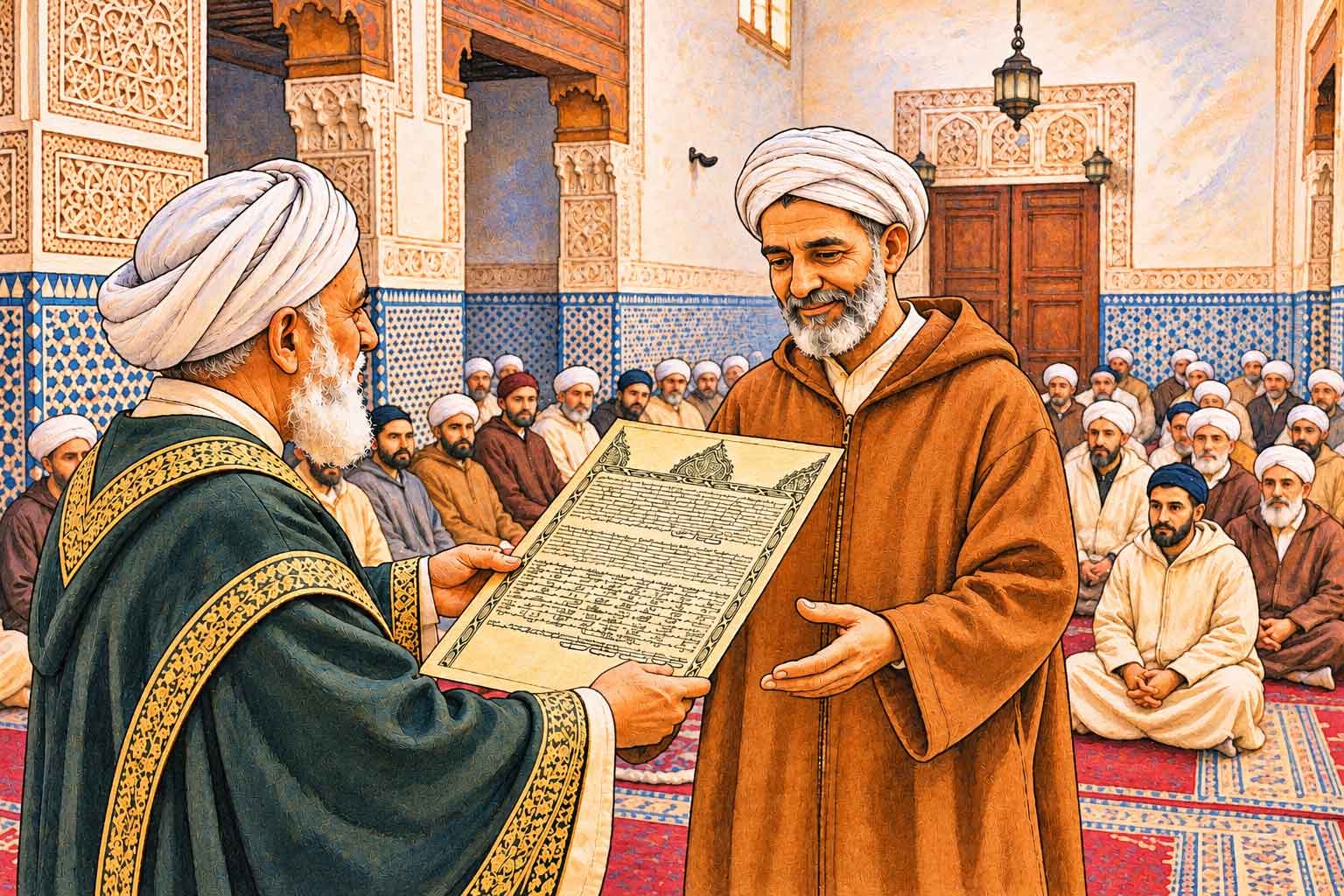
Al ijazah (Arabic: الإِجازَة , lit. “permission”, but meaning “authorization, license” in a technical sense) is a license authorizing its holder to transmit a certain text or subject, which is issued by someone already possessing such authority1. The principle of ijāzah developed in the Arab-Muslim heritage appeared in the 4th century A.H. (10th century AD), which was then applied in the educational system as a whole. Originally, it was a tradition developed by Muslims for the Islamic sciences, like hadīth and tafsīr. The ijâzah was not attributed solely to the religious sciences. It applied equally to all the sciences of life and the universe. It was the same in medical science. The chief of physicians of the fourth century of the Hegira, Sinan ibn Thabit, attributed ijazza to all who wished to practice medicine, after having passed an examination in the specialty which they wished to practice2. As a result, various ijāzahs in Islamic sciences and in other fields including medicine were delivered from different institutions and Universities in the Muslim world. Al-Qarawiyyin University (AU) was one of them. It was founded in 859 C.E., by a young princess named Fatima Al-Fihri who migrated with her father Mohammed Al-Fihri from Qayrawan (Tunisia) to Fes3. Al-Qarawiyyin grew to become one of the leading spiritual and educational centers in the Muslim world, attracting scholars and students from various locations. It expanded its course offering to include educational subjects apart from religious teachings, including natural sciences, medicine, mathematics and music. In this article, we will try to present and analyse the last documented medical ijāzah delivered in Fez in the 19th century and then translate the same ijāzah into English.
Definition and types of Ijazah
Ijāzah is an Arabic term derived from the root-verb ‘ajaza’ which means, as al-Fayruzabadi, in his al-Qamus al-Muhit, in this regard says to give permission, licence or authorization4. The term ijazah refers to several distinct types of academic certificates in common use in medieval Islamic scholarship. It was first coined to authorize the transmission of hadith. But with legal studies, it began to be used with complements in order to distinguish it from the hadith5. Al-Qalqashandi defines three categories of ijazah in common usage in Mamluk Egypt and Syria, including not only the license of transmission but also the ‘ard (presentation of books) and the ijazat al-ifta’ wa’l-tadris (license for issuing legal opinions and teaching law)6. The license to teach law and issue legal opinions (ijazat al-ifta’ wa ‘l-tadris; also ijazat al-tadris wa’l-ifta’ or simply ijazat al-ifta’) is the type of ijazah that resembles the medieval European university degree most closely, since, rather than authorizing the recipient to transmit or teach a particular text, it attests to his or her mastery of an entire field (in this case, the law) and permits entry into professional categories: law professor (mudarris) and jurisconsult (mufti). The main difference between the two is that the granting authority is an individual professor, in the Islamic case, rather than a corporate institution in the case of the university7.The acquisition of ijazahs played an important part in establishing scholarly status by documenting links to earlier generations of scholars in the Muslim community8.
Ijazah in medicine (Medical degree)
For the medical sciences, in the Muslim world the importance of the medical profession was so well recognized that, from the beginning of the tenth century A.D., physicians had to pass an examination and obtain a certification without which they would not be allowed to practice this profession.
Ali Ibn Rabban of Tabaristan, a Persian physician from the southern part of the Caspian Sea, entered the service of Caliph Al-Mutawakkil as court physician in Baghdad. In 850 AD, he completed his 550-page medical compendium called “The Paradise of Wisdom” in which he wrote: “He who perpends this book with understanding resembles one who wanders in fruitful and pleasant gardens, or in the markets of great cities, wherein is provided for each of the senses its pleasure and delight. But just as he who limits his knowledge of such gardens and cities to the contemplation of their gates is as one who sees naught of them, so he who enumerates the chapters of this my book without attentively reading what is contained in each, doth not understand the true meaning of what I say… But he who masters this book, and fully fathoms and perpends it, will find in it the greater part of what the young graduate needs of the Science of Medicine and the action of the natural forces in this Microcosm and also in the Macrocosm”9.
The reference to “graduate”, translated from the Arabic “mutakharrij”, meaning one who has “exited through” a course of medical study, is undoubtedly a historic first10.
In the same way Al Rhazi’s book on examining and appointing physicians, and his treatise on the tricks of charlatans11, had paved the way for organizing the medical profession. In 931 A.D Shortly after the Rhazi’s death, due to the commitment of a case of medical malpractice, the Caliph Al Muqtadir ordered Sinan ibn Thabit ibn-Qurra (chief physician) to subject all practicing physicians to a special examination and to issue a testimony to those who meet the exam standards. Eight hundred and sixty physicians passed this exam in Baghdad and thus the city abolished charlatanism. It is known that one question was always put to each examinee: Who was your teacher? The answer had to be accompanied by certified evidence12. A teacher usually wrote, in his own handwriting, on pages of the book or books that were studied under him, a report in the form of a licence (Ijaza) testifying to the student’s abilities. Many of these licences, signed by famous physicians, have survived in Arabic manuscripts13.
Content of Ijazah in Medicine
The form and content of ijazahs, may have varied depending on the type of Ijazah, but they usually followed a relatively standard outline:
- An opening prayer, praising God and blessing the Prophet Muhammad (PBUH);
- The praise of knowledge and its importance: Here usually those verses of the Quran and hadīths of the Prophet which are related to the significance of knowledge are mentioned such as the following Qur’anic verse: “Say: ‘Are those equal those who know and those who do not know? And the hadīth such as: “If anyone travels on a road in search of knowledge, Allah will cause him to travel on one of the roads to Paradise”.
- Specifically the praise of medicine and medical knowledge and its importance relying on some Hadiths of the Prophet (PBUH) such: “Verily, Allah sent down the disease and the cure, and for every disease he made a cure. Seek treatment, but do not seek treatment by the unlawful.”
- An introduction of the student, with genealogy, indicating his moral qualities as well as his medical knowledge and accomplishments;
- The names of professor(s) who examined the student and who will give him the permission to practice medicine
- Then the examining professor proceeds to give advice to the new physician as to how he should use his knowledge, treat his future patients, exercise his function as a wise man (HAKIM) within his society in a merciful manner.
- Finally, the ijāzah normally ends with a prayer, date of issue, and a professor’s or jury members’ ratification of the ijāzah either by seal or signature, or both. Having explained briefly the tradition of ijāzah in the Muslim world, now we shall present the ijāzah of Al Haj Muhammed, son of Haj Ahmed AL KAHHAK granted by Al Quarawiyin University in Fez14.
A Moroccan Physician’s Medical Degree – Fez, 1832 A.D15
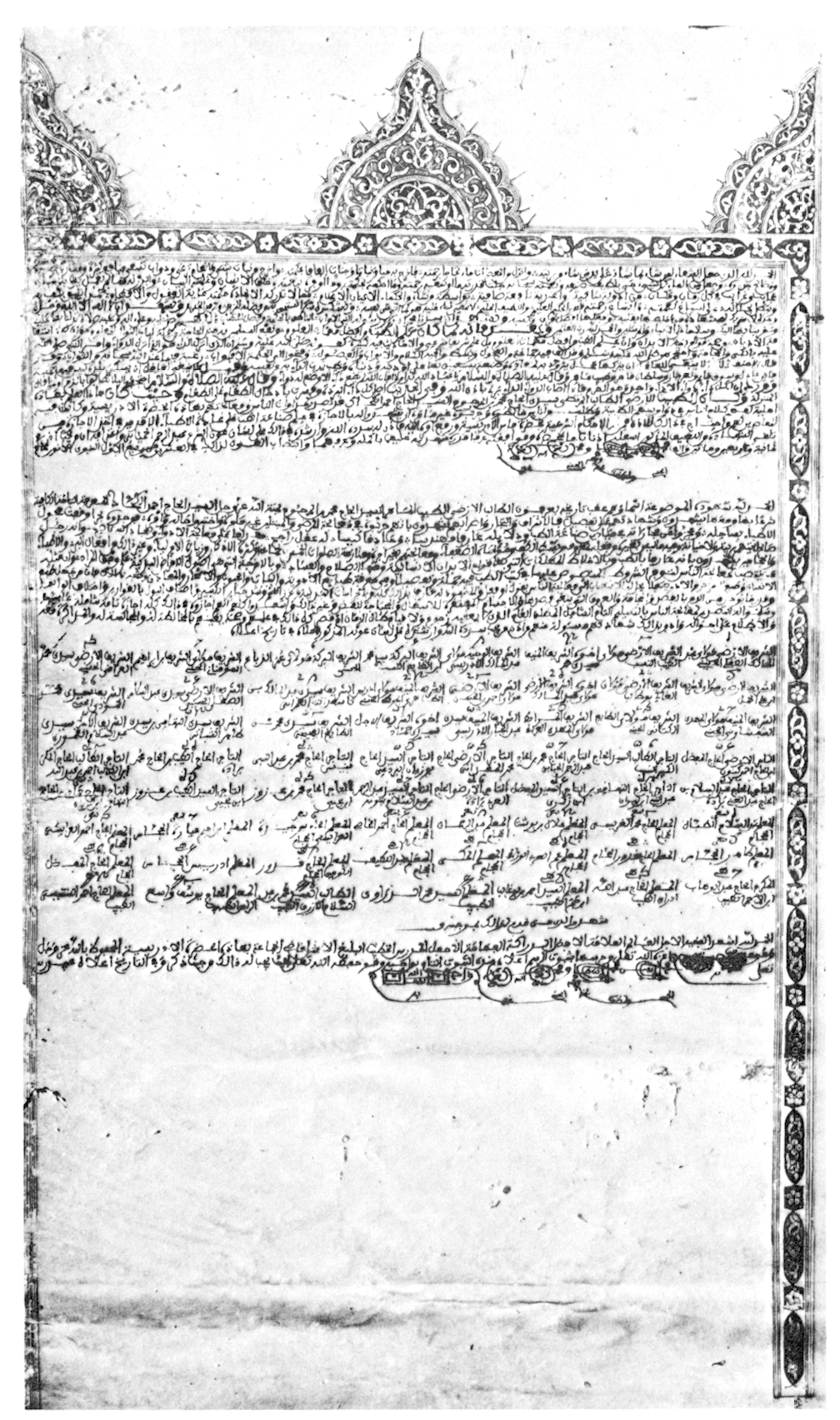
The licence was granted, in Fez, to physician Al Haj Muhammed, son of Haj Ahmed AL KAHHAK. It had the form of an authenticated title deed drawn up in front of sworn notaries who, by a writ from the city Head Magistrate (قاضي الجماعة), had recorded the declarations of scholars, physicians and various notables of the capital (i.e. Fez). It is very likely that such certificates might have existed in Morocco before the XIIIth century A.H, though none has been found, up to now. So the first licence under date of the known ‘Ijazas’ seems to be that of Friday 20th Rabiâ I, 1248 A.H (17th August 1832 A.D), the translation of which into English is as follows.
a- Description of the form
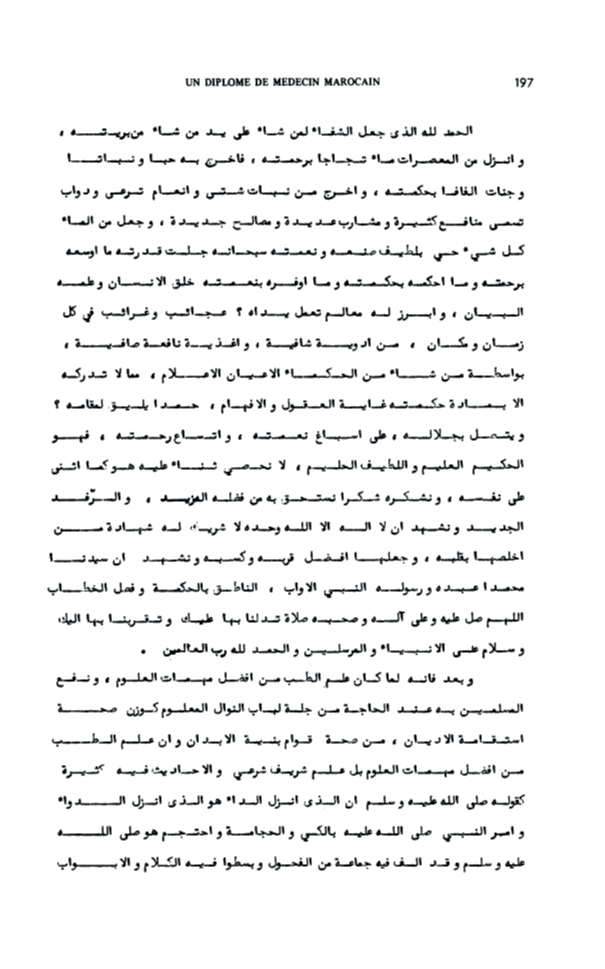
The text of the licence, in a beautiful calligraphy of those days, is on real parchment, in a frame of iridescent colourings: red, green, blue and gold. It still keeps its freshness, after more than one and a half centuries.
b- Description of the content
The preamble, focussing in general on the importance of Medicine for Muslims, points out the grantee’s professional rank in Fez. After the preamble, comes the text of the ‘Ijâza’ itself, followed by the names of the sixty-three witnesses, and bearing the paraphs of the three notaries in charge of making record of the witnesses’ declarations. All of which is endorsed and signed by the Head Magistrate, the supreme judicial instance and the Sultan’s representative. Of note. The witnesses’ names are mentioned in the following order: 1) The chorafas (Prophet Muhammed’s descendants), who usually have some understanding of the general knowledge of their time; 2) merchants and notables; 3) barber- healers who used to practise dental extraction and bloodletting, and to tend to wounds, fractures and sprains; and 4) the physicians of the city.
c- The historical context of the licence
It has been delivered in the reign of Sultan Moulay Abdar-Rahman Ibn Hicham, a king from the Alaoui Family. His reign was in a period that one can call ‘The Moroccan Socio- Cultural Renaissance’. We can also consider the document as unique of its kind because, in addition to its main subject matter, it allows us to know, by names, the existence of seven other Moroccan colleagues of the grantee’s.
d- The translated text of the ijaza in English16.
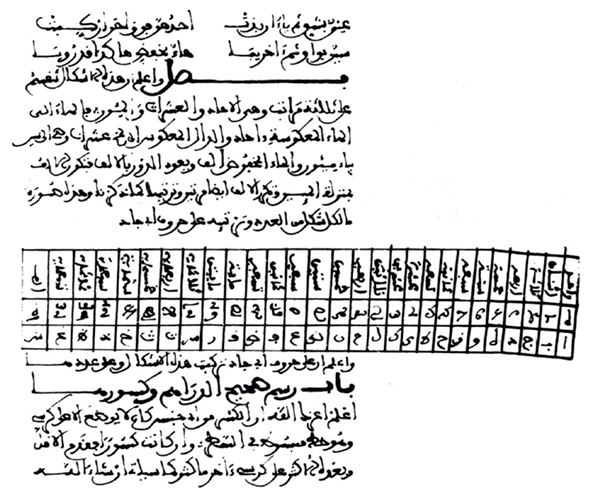
Finally, we include, attached to the document’s translation, a photocopy of a manuscript sheet, which Rabat General Library have kindly handed out to us. It explains the correspondence of the usual Arab cardinal numbers to those called ‘Fez Numbers’ (Al Qalam Al Fassi). The Fez Numbers were used to number, in order of importance, the sixty-three witnesses mentioned on the lists in the last part of the licence document. Those witnesses who, in the absence of any university authority in the modern sense of the term, assumed under judicial responsibility, the role of ‘Jury’ to grant the title of Medical Competency to physician Haj Muhammed AL KAHHAK.
A MOROCCAN PHYSICIAN’S MEDICAL DEGREE- FÈS, 1832 A.D
IJÂZA (LICENCE)
All praise to Allah, who entrusts the cure of the person He wants to cure, by the means that please Him, to a person He himself chooses amongst his creatures. Allah who, by his effective mercy, pours down from the clouds clear water that gives birth to seeds, plants and dense gardens, according to the Laws of his wisdom. Allah who lets out numerous plants, grazing herds and beasts that look for their food on the ground, a good number of useful elements, several beverages, and new remedies. Allah who, by his effective kindness and generosity, makes of water an essential element for life for any living being. Allah whose power is great, whose mercy is immense, whose wisdom is endless, whose generosity is boundless. He has created Man and has taught him language. He has revealed to him, in all times and places, through great scholars, the most extraordinary and rare marvels that he could not have realized before; such marvels as efficient remedies, healing drugs, and useful healthy foods, which only superior minds can grasp, thanks to the assistance of Allah’s wisdom. That a praise worthy of Allah’s rank and majesty be addressed to him for all the overflowing wealth he provides us with, and for the immense mercy that he allows us to benefit from. He is the Wise, the Intelligent, the Clement, and the Merciful. The praise we owe him can never equal the praise that deserves his perfection he himself has described to us.
We bear witness that there is no other god but Allah and that he has no associate, a testimony that springs up from the depths of our hearts and which brings us nearer to him. We also bear witness that our Lord Muhammed is Allah’s slave and messenger; that he is the repentant prophet, whose words are the expression of wisdom, and whose judgement is infallible. O, Allah! May you spread your blessings upon him, his family and companions; Blessings that make us better feel your existence and bring us nearer to you. May your salvation be upon all your prophets and messengers!
Praise to Allah, Master of all the worlds. Considering that Medicine is one of the most important sciences; that it is essential for Muslims, whose degree of faith for example depends on how much the body is healthy; that it is a noble science, whose practice conforms to canonical laws.
Considering that it is the subject matter of numerous prophets‘ sayings (hadiths), such as the following: “Allah, who has brought down illness to Earth, has also brought down a remedy to it.” “Take care of yourself, for Allah has not created illness without creating a remedy”, “Do bloodletting to prevent apoplexy”, “Tend to yourself, for each illness has its remedy, except decrepitude; a suitable remedy results in cure, Please Allah.”, and “The origin of any illness is bulimia, i.e. ingestion of huge quantities of food”;
Considering that the prophet has allowed the practice of ignipuncture and bloodletting, which he himself has used.
Considering that a number of physicians have written books where they have lengthily exposed medical issues, and thus widely opening vistas to medical practice, hoping to deserve Allah’s reward in the Beyond.
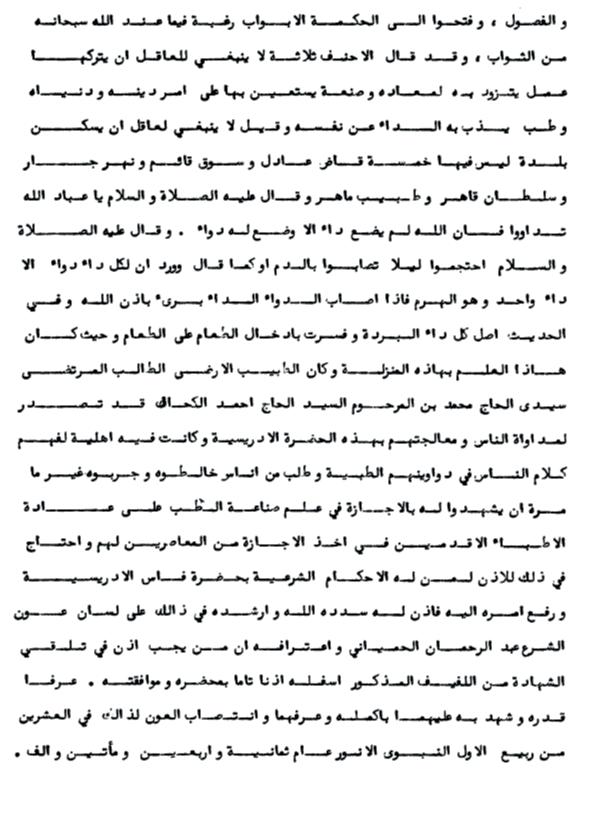
Considering Al Ahnaf’s saying: “There are three things a wise person should not do without: accomplishing good works that will provide for one’s journey in the Beyond, looking for a profession that allows for carrying out religious duties and providing for material needs, acquiring medical knowledge to fight diseases. A wise person, too, should avoid living in a place lacking in five things: an honest judge, an active market, a running river, efficient authority, a skilful physician.”
Thus, considering such importance that Medicine involves.
Whereas the honourable physician and respectable researcher Sidi Al Haj Muhammed, son of late Al Haj Ahmed AL KAHHAK, devotes his time to taking care of the inhabitants of the Idrissi capital (Fez); that he is able enough to comprehend medical books’ terminology.
Considering that he has solicited persons who have associated with him, and who have tested his knowledge several times, to attest to his competence in medical art, according to the old custom of physicians who would request such licence from their contemporaries.
Whereas the Head Magistrate’s permit is necessary to obtain the witnesses’ declarations, the Magistrate has intimated, through his duly commissioned bailiff Abdar Rahman Al Hamyani, to the instrumental notaries the order to draw up the Ijâza Act.
Follows the LAFIF ACT (LEGI0N ACT), drawn up on 20th Rabiâ I, 1248 A.H (August 17, 1832).
CONTENT OF THE WITNESSES’S LEGION (THE LAFIF) ACT, which constitutes the LICENCE (IJÂZA)
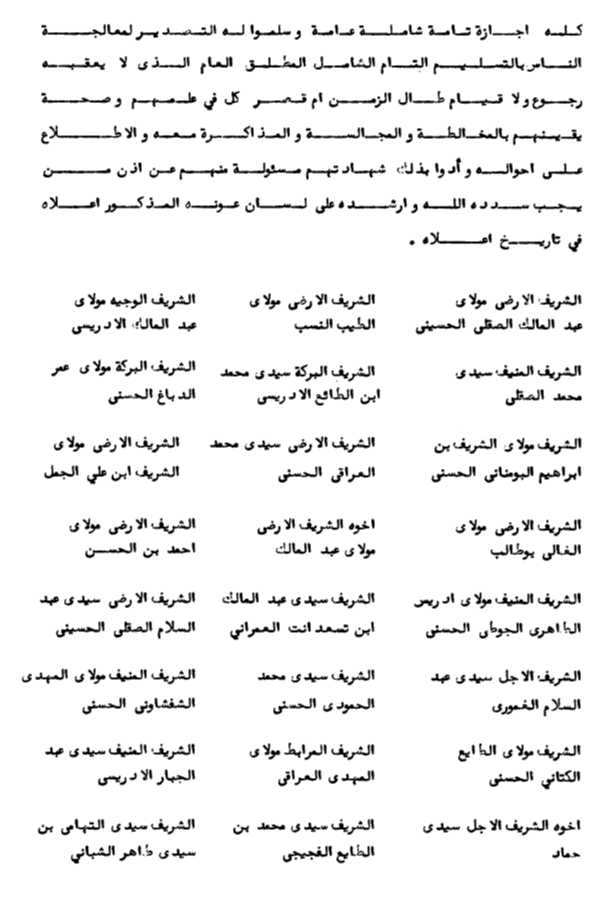
All praise to Allah. By the presents, the witnesses whose names appear below the date of the document declare that they perfectly know in a legally sufficient manner the honourable researcher and skilful physician Sidi Al Haj Muhammed, son of late Al Haj Ahmed AL KAHHAK. Moreover, they attest, whether chorafas, notables or belonging to other classes of the same rank in the order of their designation below, that they have put to proof the above-mentioned applicant’s aptitude in healing the sick on several occasions. The witnesses have also ascertained what follows.
- That the applicant’s knowledge is like an ocean, on whose shore the best physicians have stopped standstill, unable to match him in medical art and in diagnosis,
- That he is expert, ingenious, perspicacious, full of common sense, level headed, skilful in preparing remedies, and of good counsel to his fellow-creatures. That he is virtuous, above any suspicion, and incapable of any deceit,
- That he excels all other physicians in carrying out his medical duties,
- That he is generous and full of solicitude for the lowly, whom he cares for benevolently,
- That he regularly accomplishes the five prayers in common, multiplies orisons, visits saints’ tombs, and devotes himself to all sorts of deeds of piety,
- That, furthermore, his fellow physicians and healers acknowledge that he is expert in medical art and in the knowledge of tissue-fluids, whose equilibrium is the source of a healthy functioning of the human body, and upon which depend virtue and vice, as well as the different temperaments to which illnesses can be traced back,
- That it is such people like him, who should propose their services to their fellow-creatures for the medical care they need. For he fully fulfils the conditions required in the medical profession, namely knowledge of the nature of drugs, plants, seeds, trees, animals, etc. (In fact, it is obvious that a person ignorant of Man’s nature, the nature of human diseases and their remedies, cannot claim to take up the profession of curing his fellow-creatures, neither by word or by action),
- That the applicant gives proof of possessing all the warranties of knowledge in all that have been mentioned above, as well as in the art of wound- healing, sewing up torn tissues and resetting broken bones,
- That he knows how to identify different varieties of urine in crystal phials, according to the urine colours, the proper quantity of blood to take off the veins, or off the neck in the case of bloodletting, the veins to cut in for that effect, and in what cases it is suitable to administer a purge, or an astringent.
For such cares and specific cases as mentioned above, the witnesses give their total approbation to the applicant; and they attest his entire and total competence in the matter of medical care and medical knowledge. An attestation that has legal authenticity and that constitutes a perfect total licence in his favour. This is why they confer on him the right to practice the medical profession, in a wide way, as totally and entirely approved for evermore. The witnesses also confirm that they can in no way come back on what they have affirmed above, neither now nor in a nearer or far-away future, on what they know on their association and discussion with the applicant and the perfect circumstances of that knowledge.
Duly acknowledged, drawn up on order of the right – May Allah Assist and Back him up – and passed on through his bailiff on the aforementioned date
Follow the names of the (63) witnesses:
The eminent and most distinguished ‘chorafas’:
1- Moulay Abdelmalek Skalli Houssaini,
2- Moulay Taîb Skalli,
3- Sidi Mohamed Skalli,
4- Moulay Abdelmalek El Idrissi,
5- Moulay Cherif Ben Brahim El Moumnani El Hassani,
6- Sidi Mohamed Ben Tayaa El Idrissi,
7- Moulay Omar Debbagh El Hassani,
8- Sidi Mohamed Laraki El Hassani,
9- Moulay Cherif Ben Ali El Jamal,
10- Moulay El Ghali Botaleb,
11- Moulay Abdelmalek Boutaleb,
12- Moulay Ahmed Ben Lahcen,
13- Moulay Driss Tahiri El Jouti El Hassani,
14- Sidi Abdelmalek Ben Tassadanet El Amrani,
15- Sidi Abdeslam Skalli El Houssaini,
16- Sidi Abdeslam El -Ghmouri,
17- Sidi Mohamed El Hmoudi El Hassani,
18- Moulay El Mehdi Chefchaouni El Hassani,
19- Moulay Tayaa El Kettani El Hassani,
20- Le Marabout Moulay El Mehdi Laraki,
21- Sidi Abdeljabbar El Idrissi,
22- Cherif Sidi Hammad El Hassani,
23- Sidi Mohamed Ben Tayaa El Fijiji,
24- Moulay Thami Ben Tahar Chbani,
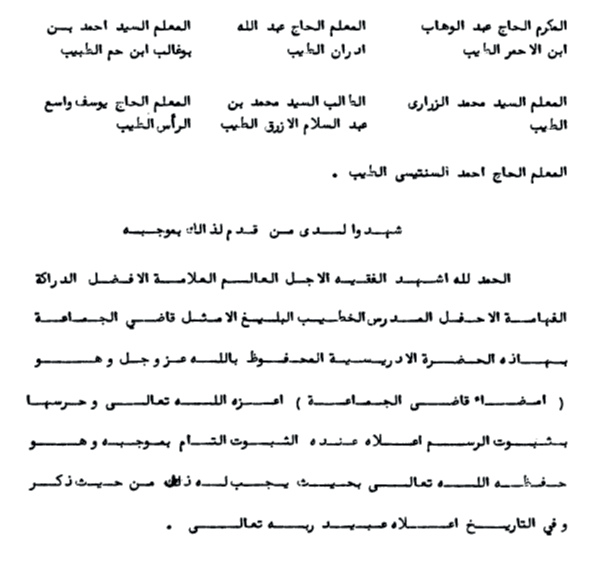
Merchants and Notables:
1- Haj Mfeddel Ben Haj Ahmed Guennoun,
2- Haj Mohamed El Maadani,
3- Haj El Kebir El Maadani,
4- Haj Bouziane El Berdaî,
5- Haj Mohamed Ben Haj Abdrarahmane El Hbabi,
6- Haj Mohamede Ben Abdenbi Bennis,
7- Haj Taîb Ben Haj Mohamee Berrada,
8- Haj Thami Ben Abdenbi Benkirane,
9- Abdarrahmane Ben Abdeslam Bennouna,
10- Haj Hammad Ben Haj Thami Benkirane,
11- Haj El Mekki Ben Ahmed Ben Abdellah,
12- Haj Abdeslam Ben Haj Abdelghnini Berrada,
13- Mfeddel Benzekri,
14- Haj Larbi Berrada,
15- Haj Mohameed Ben Azzouz Ben Yahya,
16- Taîb Ben Azzouz Ben Yahya,
Barber-Healers:
1- Maalem Aallal Ben Bouchta,
2- Maalem Haj Boujida Laraichi,
3- Maalem Tahar,
4- Maalem El Mekki,
5- Maalem Driss,
6- Maalem Abdeslam Tabbal,
7- Maalem Abdarrahmane,
8- Maalem Brahim Miara,
9- Maalem Haj Kaddour,
10- Maalem Abdellatif,
11- Haj Lamfaddal,
12- Haj Mohamed Laghrissi,
13- Haj Ahmed El Khsassi,
14- Haj Ahmed Laraichi,
15- Maalem Omar Ben Larbi El Ouazzani,
16- Haj Kaddour El Goumi,
Physicians:
1- Distinguished Haj Abdelouahab Ben Lahmar,
2- Maalem Si Mohamed Zirari,
3- Maalem Haj Ahmed Sentissi,
4- Maalem Haj Abdallah Ardane,
5- Talib Si Mohamed Ben Abdeslam Lazrak,
6- Maalem Haj Ahmed Ben Boughaleb Ben Hammou,
7- Maalem Haj Youssef Ouassaa Arras
Follows, in the Great Magistrate’s handwriting: “who have duly filed before the officer to this effect –validated,”
Homologation Mention:
All praise to Allah. The Jurisconsult, fine lettered and distinguished Professor, eloquent Orator, and valiant Head Magistrate of the Idrissi capital Fez, wherein he takes due office,
(Here his paraphs),
May Allah protect him and treat him with clemency,
Has ascertained that the above Act is in due form, and that he homologates it on the same date as above.
The slave of his Lord Allah – signed.
Bibliographie
- https://en.wikipedia.org/wiki/Ijazah
- George Makdisi. The Rise of Colleges.
- Abdelhadi Tazi. 11 centuries History of the Qaraouiyn, 1948
- Al-Fayruzabadi, Al-Qamus al-Muhit, ed. by M. Naim al-Araqsusi,3rd edition, (Beirut: Muesset al-Risalah, 1993) p.652.
- George Makdissi. The rise of college.
- Al-Qalqashandi . Ṣubḥ al-aʿshā.
- Law and Education in Medieval Islam. Studies in Memory of Professor George Makdisi. Ed. JosephLowry, Devin Stewart, and Shawkat Toorawa. E.J.W. Gibb Memorial Trust, 2004.
- Ibid
- Browne EG. Arabian Medicine. Cambridge: The University Press; 1962: 38 – 41.
- Browne EG. Arabian Medicine. Cambridge: The University Press; 1962: 38 – 41.
- A.Z Iskandar. Al Rhazi Wa Mihnat Attabib, Al Machriq, 1960,54, p 471-522.
- Qiffti. The History of Learned Men (Kitab Ikhbar al-‘ulama’ biakhbar al-hukama’ , usually referred to simply as Ta’rikh al-hukama’ ). P 191-192
- J.D. North, J.J. Roche. The Light of Nature: Essays in the History and Philosophy of Science …
14 . It’s not mentioned in the Ijaza that it was granted from Al Quarawiyin University, but it’s a conclusion as Al quarawiyin was the unique institution who can deliver such Ijaza - Kahhak Abdelkader. Un diplôme de médecin marocain à Fès en 1832. In: Revue de l’Occident musulman et de la Méditerranée, N°7, 1970. pp. 195-210.
- Translated by Jaafar Essadik BENKHALDOUN, from Abdelkader KAHHAK’s original French version